


Legiones Astartes – Kor Phaeron

Scorned by many in his Legion as a ‘half Astartes’, Kor Phaeron was Lorgar’s surrogate father and his tutor in the ancient ways and rites of Colchis. By the time the XVIIth Legion was united with its Primarch, Kor Phaeron was too old to undergo the full implantation process, but so favoured was he in the eyes of his Primarch that he received the most potent of augments possible to bestow upon a man short of elevation to the Legiones Astartes, and was declared First Captain. In this role, Kor Phaeron exerted great influence upon his Primarch and within his Legion, his conviction and zeal unfettered and undiminished.
| LD | CL | WP | IN | |||||||||||
| M | WS | BS | S | T | W | I | A | LD | CL | WP | IN | SAV | INV | |
| Kor Phaeron (⌀40mm) | 10 | 10 | 9 | 7 | ||||||||||
| Kor Phaeron (⌀40mm) | 6 | 5 | 4 | 3 | 3 | 3 | 3 | 4 | 10 | 10 | 9 | 7 | 2+ | 5+ |
- Patriarch’s Claws
- Digi-flamer
- Traitor
- Word Bearers
- Master of the Legion
- Bulky (2)
- Dark Oratory
- Jealous Command
- Slow and Purposeful
- Infantry (Unique, Command)
Patriarch’s Claws
Crafted to allow Kor Phaeron to fight among the enhanced ranks of the Space Marines without becoming outmatched and to reflect the twisted cruelty that was his hallmark in combat, the Patriarch’s Claws are a matched pair of Charnabal fighting claws that do not require the strength of a full member of the Legiones Astartes to rend flesh and slice through armour.
| Melee Weapon | |||||||
Melee Weapon | IM | AM | SM | AP | D | Special Rules | Traits |
| Patriarch’s Claws | |||||||
| Patriarch’s Claws | I | A | S | 2 | 1 | Shred (6+) | Power |
Digi-flamer
Concealed within Kor Phaeron’s regalia of office is a miniaturised flamer weapon.
| Ranged Weapon | |||||||
Ranged Weapon | R | FP | RS | AP | D | Special Rules | Traits |
| Digi-flamer | |||||||
| Digi-flamer | Template | 1 | 4 | - | 1 | Template | Flame, Assault |
Dark Oratory
Kor Phaeron’s mastery of oratory is legendary, swaying whole populations to the Imperial cause during the Great Crusade before later being put to a darker purpose.
Kor Phaeron’s Controlling Player may apply additional Special Rules to friendly Units in the Effects Sub-Phase.In this Model’s Controlling Player’s Effects Sub-Phase, this Model’s Controlling Player can select one friendly Unit which only includes Models with the Word Bearers Trait within 6" of this Model, then select one of the following effects:
- Cruel Invective: Until the start of the Controlling Player’s next Effects Sub-Phase, all Models in the selected Unit gain the Hatred (Loyalist) Special Rule.
- Threatening Entreaties: Until the start of the Controlling Player’s next Effects Sub-Phase, modify the Leadership and Cool Characteristics of all Models in the selected Unit by +2.
Jealous Command
Kor Phaeron was known within the Legion for his unfailing arrogance and vindictive sense of pride. He would tolerate none above him, save his adopted son and Primarch Lorgar. The Primarch was the only man that Kor Phaeron would bend the knee to - though many wondered if he did so out of respect or so that he could manipulate the Primarch from the arm of his throne.
Kor Phaeron’s Characteristics increase if he is the only Unique Model in the Army.If this Model is the only Model with the Unique Sub-Type in your Army, modify this Model’s Wounds and Leadership Characteristics by +1.
For example, a Legionary selected from the Imperial Fists Faction and selected as part of a Loyalist Army would have the Loyalist and Imperial Fists Traits. On their own these Traits have no effect on the Model’s Characteristics, Points cost or other features, but Rules that target Imperial Fists or Loyalist Models will apply their effects to the Model.
In addition to Models, Weapons can also have Traits. These are usually different to those possessed by Models, but are used for the same purposes. Weapons will commonly have Traits that define the type of Weapon it is or a specific type of usage. For example, a bolt pistol has the following Traits: Assault, Bolt. These identify which ‘family’ of Weapons it belongs to for any Rules that might only affect ‘Bolt’ Weapons and notes that it can be used for attacks where only ‘Assault’ Weapons may be used.
While they appear similar to Characteristics, it is important to note that Traits never have a ‘value’ attached to them. Furthermore, Traits cannot be modified in any way by another Special Rule or effect during a Battle, unless a Rule specifically states it affects a Trait.
Infantry units include all types of foot soldiers. Infantry are fairly slow moving, but can cross almost any terrain and make the best use of cover to avoid enemy fire.
Infantry is the most basic Type, and is applied to most Models in the game. A Model with the Infantry Type uses the Core Rules without modification, gaining neither benefit nor penalty. Models with the Infantry Type may Embark and Disembark upon Models with the Transport Sub-Type.The Word Bearers Trait is used in the following Legiones Astartes datasheets:
Designed to rip and tear flesh, some weapons are fearsome and intimidating tools of warfare. Whether by the gnashing teeth of a chainblade or the jagged edges of flechette ammunition, these weapons scythe great holes in the lines of even the toughest of infantry and the largest of warriors.
Attacks made with the Shred (X) Special Rule can sometimes inflict an extra point of Damage.When any Wound Test is made for an attack with the Shred (X) Special Rule, if the result of the Dice roll, before any modifiers are applied, is equal to or greater than the value of X attached to this variant of the Shred (X) Special Rule, then if a wound is inflicted by that Wound Test, the Damage Characteristic of that wound is increased by 1. Note that the Shred (X) Special Rule may only be triggered by a Wound Test and has no effect when making an Armour Penetration Test.
A Model is Engaged if either:
- That Model is in Base Contact with an enemy Model in the same Combat.
- That Model is no more than 2" from another Model in the same Unit which is in Base Contact with an enemy Model.
Template weapons shoot clouds of fire, gas or other lethal substances, rather than shells or bullets.
Weapons and attacks with the Template Special Rule use the Flame Template to determine how many Models they Hit.When making attacks for a Weapon or other effect that has the Template Special Rule, or otherwise uses a Template, no Hit Tests are made for the attack. Instead, when directed to make Hit Tests for such an attack, a single Template is placed to determine how many Hits are generated. A Template must be placed so that its narrow end is touching the Base of the Model, the edge of a Model’s Hull (if it has the Vehicle Type) or other point being used to make the attack, and so that no part of the Template covers or touches a friendly Model’s Base, Hull or otherwise would inflict Hits on a friendly Model. Within these restrictions, the Player making the attack may place the Template in an orientation of their choosing as long as at least one Model from the original Target Unit remains under the Template. If the Template cannot be placed under these restrictions, such as if it cannot be placed without covering or touching friendly Models, then no attack may be made.
Once the Template has been placed, a number of Hits using the profile of the Weapon or effect are inflicted on the Target Unit equal to the number of Models touched or covered by the Template. If the Weapon or attack has a Firepower Characteristic greater than 1 then only a single Template is placed, but the number of Hits inflicted per Model touched or covered by the Template is equal to the Firepower Characteristic of the attack or Weapon. If more than one enemy Unit has Models that are touched or covered by the Template in its final position, then Hits are inflicted on all such Units as noted above, Hits on Units other than the original target form a new Fire Group that must be placed to one side and used to resolve a separate Shooting Attack on the additional Target Unit once all attacks and Fire Groups from the original Shooting Attack have been fully resolved. When resolving Armour Penetration Tests for Hits inflicted by a Weapon with this Special Rule, the position of the Model that was used to make the attack is used to determine which Armour Facing is used.
Note that the Rules require a Template to be placed in Base Contact with the Model being used to make the attack, but this Model is not counted as having been Hit by the attack and does not stop the attack from being made. However, this only applies to the individual Model being used to make the attack, not to other Models in the same Unit.
Weapons with this Special Rule will have their Range Characteristic as Template’. This does not count as a value of ‘0’ or ‘-’. If a Rule requires a number for the Range Characteristic then all Weapons and attacks with this Special Rule are considered to have a Range Characteristic of ‘8’.
In some rare cases a Weapon may use a different Template than the standard Flame Template, in these cases the Template Rule may be expressed with a bracketed section stating which Template must be used when attacking with that Weapon. Otherwise, the Rules for its use are unchanged from those noted under the Template Special Rule, with the exception of the Range Characteristic it is considered to have.
An example of this is the use of the Hellstorm Template for certain very large Weapons. In this case the Rule would be expressed as ‘Template (Hellstorm)’ and the attack would be resolved using the Template Special Rule, but placing the larger Hellstorm Template. Weapons with the Template (Hellstorm) Special Rule are considered to have a Range Characteristic of ‘16’ when a Rule requires such weapons to have a numbered Range Characteristic.
The Master of the Legion Trait is used in the following Legiones Astartes datasheets:
Among the warriors and war machines of the Horus Heresy there are many whose names are known throughout the galaxy. Such heroes, prototypes and icons are rare, and though their power can tip any battle in their favour, they can only be in one place at a time.
The following Rules apply to all Models with the Unique Sub-Type:- An Army may not include more than a single instance of a given Model with this Sub-Type. For example, if Model A and Model B both have the Unique Sub-Type then a single Army could include one of Model A and one of Model B, but no more than one of either Model.
- A Model with the Unique Sub-Type or a Unit composed entirely of Models with the Unique Sub-Type may not have any options other than those included on its Army List Profile selected for them.
Transport vehicles are designed to balance armour and capacity, attempting to mount the most protection without compromising how many warriors they can carry. Yet, some warriors are plated in such imposing armour or even spawned in such an aberrant nature that they occupy far more space than any regular fighter. Such warriors are mighty in both power and stature, but prove more difficult to ferry into battle.
Models with the Bulky (X) Special Rule take up more space on Transport Models.A Model with the Bulky (X) Special Rule does not use up 1 Point of Transport Capacity when it Embarks on a Model with the Transport Sub-Type. Instead it uses up a number of points of Transport Capacity equal to the value of X attached to the variant of the Bulky (X) possessed by that Model.
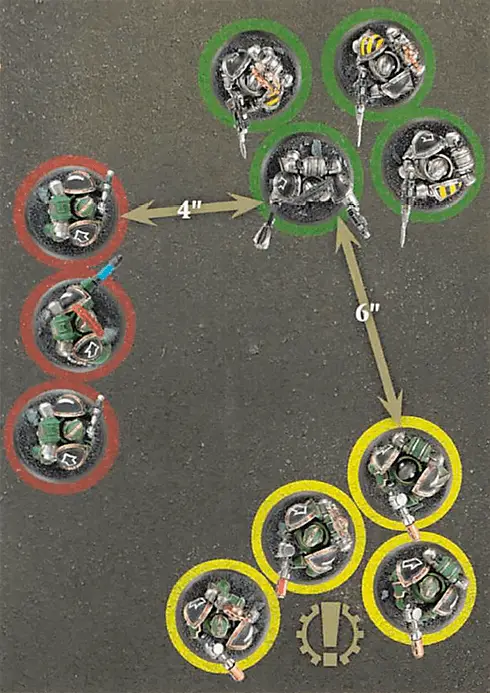
Many warriors are steady but sure, slow to advance but no less deadly for it.
Models with this Special Rule cannot Pursue fleeing enemy Units.In Step 4 of the Resolution Sub-Phase, a Player that has won Combat cannot choose for a Unit that includes any Models with this Special Rule to Pursue, and must instead select another eligible option for that Unit.
Representing the elite of any army, commanders oversee the disposition of their troops, set strategy for the coming battle and often stand at the forefront of the conflict. The actions of such heroes can change the tide of battle in an instant.
The following Rules apply to all Models with the Command Sub-Type:- A Model with the Command Sub-Type may join and leave Units.
- A Model with the Command Sub-Type may Issue and Accept Challenges.
- The Controlling Player of a Unit that includes one or more Models with the Command Sub-Type may use the Characteristics of one of those Models to resolve any Characteristic Checks made for that Unit.
This datasheet has High Command Battlefield Role. Full list of Legiones Astartes units sharing same Battlefield Role follows:
Hatred can be a force as potent as any munition, driving troops to fight harder and more ferociously. The Horus Heresy would stoke old hatreds and spawn many new ones, granting canny commanders ample opportunity to set troops against their chosen foes.
The Hatred (X) Special Rule grants bonuses against enemies of a specific Faction, Type or Trait.When Locked in Combat, or Engaged in a Challenge, with any enemy Models that have the Type or Trait that is the value of X, then all Models with this variant of the Hatred (X) Special Rule gain a bonus of +1 to all Wound Tests made in that Combat.
The Traitor Trait is used in the following Legiones Astartes datasheets:
The Word Bearers Trait is used in the following Legiones Astartes datasheets:
Patriarch’s Claws
Crafted to allow Kor Phaeron to fight among the enhanced ranks of the Space Marines without becoming outmatched and to reflect the twisted cruelty that was his hallmark in combat, the Patriarch’s Claws are a matched pair of Charnabal fighting claws that do not require the strength of a full member of the Legiones Astartes to rend flesh and slice through armour.
| Melee Weapon | |||||||
Melee Weapon | IM | AM | SM | AP | D | Special Rules | Traits |
| Patriarch’s Claws | |||||||
| Patriarch’s Claws | I | A | S | 2 | 1 | Shred (6+) | Power |
Digi-flamer
Concealed within Kor Phaeron’s regalia of office is a miniaturised flamer weapon.
| Ranged Weapon | |||||||
Ranged Weapon | R | FP | RS | AP | D | Special Rules | Traits |
| Digi-flamer | |||||||
| Digi-flamer | Template | 1 | 4 | - | 1 | Template | Flame, Assault |
Kor Phaeron’s mastery of oratory is legendary, swaying whole populations to the Imperial cause during the Great Crusade before later being put to a darker purpose.
Kor Phaeron’s Controlling Player may apply additional Special Rules to friendly Units in the Effects Sub-Phase.In this Model’s Controlling Player’s Effects Sub-Phase, this Model’s Controlling Player can select one friendly Unit which only includes Models with the Word Bearers Trait within 6" of this Model, then select one of the following effects:
- Cruel Invective: Until the start of the Controlling Player’s next Effects Sub-Phase, all Models in the selected Unit gain the Hatred (Loyalist) Special Rule.
- Threatening Entreaties: Until the start of the Controlling Player’s next Effects Sub-Phase, modify the Leadership and Cool Characteristics of all Models in the selected Unit by +2.
Kor Phaeron was known within the Legion for his unfailing arrogance and vindictive sense of pride. He would tolerate none above him, save his adopted son and Primarch Lorgar. The Primarch was the only man that Kor Phaeron would bend the knee to - though many wondered if he did so out of respect or so that he could manipulate the Primarch from the arm of his throne.
Kor Phaeron’s Characteristics increase if he is the only Unique Model in the Army.If this Model is the only Model with the Unique Sub-Type in your Army, modify this Model’s Wounds and Leadership Characteristics by +1.