


Legiones Astartes – Alpharius

Of all the Primarchs of the Legiones Astartes, Alpharius is without doubt the most steeped in mystery, legend, contradiction and deliberate falsification. Some even claim that the Alpha Legion has more than one Primarch, though it is entirely possible that this belief is itself an elaborate misdirection on the part of Alpharius, intended to further his Legion’s goals. The Primarch of the Alpha Legion shrouds himself in mystery, often moving unseen even amongst the ranks of his own Legion. However, when the time comes to cast off the cloak of misdirection, Alpharius is as awe-inspiring a being as any of the Primarchs of the Legiones Astartes. Clad in armour forged in the manner of some terrifying beast of Ancient Terran myth and armed with a fearsome panoply of weapons of unknown provenance, Alpharius bestrides the battlefield like a figure from legend. None can predict where or how the Primarch will strike, what weapons he will bring to bear or which of his many different forces will fight at his side.
| LD | CL | WP | IN | |||||||||||
| M | WS | BS | S | T | W | I | A | LD | CL | WP | IN | SAV | INV | |
| Alpharius (⌀40mm) | 12 | 10 | 10 | 11 | ||||||||||
| Alpharius (⌀40mm) | 8 | 7 | 7 | 6 | 6 | 6 | 7 | 6 | 12 | 10 | 10 | 11 | 2+ | 4+ |
- The Pale Spear
- The Hydra’s Spite
- The Pythian Scales
- Frag grenades
- Krak grenades
- Venom spheres
- [Allegiance]
- Alpha Legion
- Smokescreen
- Master of the Legion
- Sire of the Alpha Legion
- Bulky (4)
- Everywhere and Nowhere
- Eternal Warrior (2)
- Paragon (Unique, Light)
The Pale Spear
This double-bladed spear flickers seemingly out of phase with the material universe when wielded, emitting an eerie and otherworldly howling, and is able to pierce any physical defence it encounters without impediment, ripping its victim apart at the molecular level.
| Melee Weapon | |||||||
Melee Weapon | IM | AM | SM | AP | D | Special Rules | Traits |
| The Pale Spear | |||||||
| The Pale Spear | +1 | A | +1 | 2 | 2 | Critical Hit (5+), Armourbane, Phage (S) | Power |
The Hydra’s Spite
A high-powered plasma weapon recorded as in use by several highly ranked members of the Alpha Legion - the Hydra’s Spite does not suffer from many of the shortcomings common to Imperial plasma technology and may well incorporate xenos components.
| Ranged Weapon | |||||||
Ranged Weapon | R | FP | RS | AP | D | Special Rules | Traits |
| The Hydra’s Spite | |||||||
| The Hydra’s Spite | 18 | 2 | 7 | 3 | 1 | Breaching (4+) | Plasma, Assault |
The Pythian Scales
When not masquerading as a regular member of his Legion, Alpharius’ armour, faceless and fashioned after the shadowed mythic age of Ancient Terra, is known as the Pythian Scales, and can turn aside blade, energy blast and alchemical attack with equal ease.
This Model gains the Feel No Pain (4+) Special Rule against attacks made with Weapons with the Poisoned (X) Special Rule.Sire of the Alpha Legion
Alpharius is the master of the harrowing, the Alpha Legion’s preferred strategy, and he conducts his Legion in war with practised ease. In his presence every element of his forces act in perfect concert, encircling the foe and isolating each element before eliminating it.
If a Model with this Special Rule is part of an Army, then the Controlling Player may apply the following additional Special Rules to all Auxiliary, Apex and Primary Detachments that have the same Faction Trait as the Model with this Special Rule:- If four or more Troops Battlefield Role Slots in the Primary Detachment of this Army are filled with Tactical Squad Units and/or Assault Squad Units, then all Force Organisation Slots with the Troops Battlefield Role in the Primary Detachment are considered Prime Slots.
Furthermore, if a Model with this Special Rule is part of an Army, then the following Special Rules are granted to all Models with the Alpha Legion Trait in the same Army:
- When the Controlling Player of a Model with this Special Rule makes a Reserve Roll for a Unit which only includes Models with the Alpha Legion Trait, on a Reserve Roll of 5+ that Unit can enter play as if it has the Outflank Special Rule.
Everywhere and Nowhere
Of all the Primarchs there are none as unpredictable as Alpharius, for he appears at almost any location and can arrive by almost any means without warning. Those that have studied his methods can find no pattern to help predict his actions nor scheme by which his preferences could be defined.
Alpharius may be redeployed at the start of the Battle.If the Mission being played has a Deploy Armies Step, at the end of this step, the Controlling Player of a Model with this Special Rule can deploy this Model again. When they do so, this Model can leave any Unit it has joined before being Deployed and can join a different Unit by being Deployed within Unit Coherency of it if the Unit is on the Battlefield, or placed with that Unit if it is currently Embarked upon a Model with the Transport Sub-Type, if that Model has sufficient remaining Transport Capacity and is able to Transport Models with the Bulky (X) Special Rule. This Special Rule cannot be used to deploy this Model on the Battlefield outside of the Controlling Player’s Deployment Zone, or Embarked upon a Model with the Transport Sub-Type on the Battlefield outside of the Controlling Player’s Deployment Zone.
For example, a Legionary selected from the Imperial Fists Faction and selected as part of a Loyalist Army would have the Loyalist and Imperial Fists Traits. On their own these Traits have no effect on the Model’s Characteristics, Points cost or other features, but Rules that target Imperial Fists or Loyalist Models will apply their effects to the Model.
In addition to Models, Weapons can also have Traits. These are usually different to those possessed by Models, but are used for the same purposes. Weapons will commonly have Traits that define the type of Weapon it is or a specific type of usage. For example, a bolt pistol has the following Traits: Assault, Bolt. These identify which ‘family’ of Weapons it belongs to for any Rules that might only affect ‘Bolt’ Weapons and notes that it can be used for attacks where only ‘Assault’ Weapons may be used.
While they appear similar to Characteristics, it is important to note that Traits never have a ‘value’ attached to them. Furthermore, Traits cannot be modified in any way by another Special Rule or effect during a Battle, unless a Rule specifically states it affects a Trait.
In order to make a Shooting Attack for a Unit that has been selected during the Attack Sub-Phase, as part of a Reaction or for any other Rule or Sub-Phase that requires a Shooting Attack to be made, the following procedure must be followed:
As part of the Rules for conducting a Shooting Attack, the term ‘Attacking Unit’ will be used to refer to the Unit whose Models will be making attacks as part of that Shooting Attack, while the term ‘Attacking Player’ will be used to identify the Player that controls the Attacking Unit. The term ‘Target Unit’ will be used to refer to the Unit that is selected as the Target Unit for the Shooting Attack.
Some weapons trade precision for indiscriminate destruction, high explosive impacts that can devastate a wide area. From artillery shells to high energy blasts, such weapons are popular tools of destruction on the battlefields of the Horus Heresy.
Attacks made with the Blast (X) Special Rule use a Blast Marker to determine how many Hits are caused.When making attacks with a Weapon that has the Blast (X) Special Rule, before any Hit Tests are made, a Blast Marker must first be placed to determine how many Hits may be inflicted by the attack. The Player making the attack must place the Blast Marker indicated in brackets as part of the Special Rule so that the hole in the middle is entirely over the Base of any one Model in the Target Unit. Once the Blast Marker has been placed, the Player making the attack must make a Hit Test for the attack, and each Model from the Target Unit that is fully or partially under the Blast Marker will suffer 1 Hit if the Hit Test is successful.
If any Models from Units other than the Target Unit are fully or partially covered by the Blast Marker, then a new Fire Group must be created for those Hits and set to one side. Continue resolving the Shooting Attack on the original Target Unit, and once that Shooting Attack has been completely resolved begin a new Shooting Attack to resolve those additional Fire Groups generated for Units other than the original Target Unit.
If the Hit Test is unsuccessful then no Hits are inflicted and the Player making the attack must make a Scatter Roll for the Blast Marker. Once a Scatter Roll has been made for the Blast Marker and it has been moved, one Hit is inflicted on a Unit for each Model from that Unit that is wholly or partially covered by the Blast Marker.
Hits can be scored on both friendly and enemy Units by attacks using the Blast (X) Special Rule. Hits inflicted by Weapons with the Blast (X) Special Rule are allocated in the same manner as other Hits, regardless of which actual Models were under the Blast Marker and the Blast Marker may not be used to inflict Hits on specific Models.
If a Fire Group includes multiple attacks made with the Blast (X) Special Rule, do not place multiple Blast Markers. A single Blast Marker is placed using the Rules detailed above, and a Hit Test is made for each attack in that Fire Group. For each successful Hit Test, one Hit is inflicted for each Model from the target Unit that is fully or partially under the Blast Marker. If any Hit Tests are unsuccessful then, after any Hits made by successful Hit Tests are counted, a single Scatter Roll is made for the Blast Marker, regardless of the total number of unsuccessful Hit Tests. For each Hit Test that was unsuccessful, one Hit is inflicted on a Unit for each Model from that Unit that is wholly or partially covered by the Blast Marker after the Scatter Roll has been resolved.
Designed to be carefully attached to a target and blast precise holes in the thickest armour, these cumbersome devices are ill-suited to open war. However, when a vulnerable target can be isolated in battle, there are no better tools for piercing its protection.
Weapons with this Special Rule can only attack Vehicles and immobile Models.A Weapon or attack with this Special Rule may only be selected during Step 2 of any Combat in the Fight Sub-Phase if the Unit making attacks is only Locked in Combat with enemy Units composed of Models with the Vehicle Type and Models with a Movement Characteristic of ‘0’ or ‘-’. If a Unit is Locked in Combat with any enemy Units that include any Models that do not have the Vehicle Type or a Movement Characteristic of ‘0’ or ‘-’ then no Model may use a Weapon or other attack that has this Special Rule.
A Weapon or other attack with this Special Rule may also be used to make attacks targeting a Model with the Building Type or a Terrain Piece that has a Toughness or Armour Characteristic.
Krak grenades
| Melee Weapon | |||||||
Melee Weapon | IM | AM | SM | AP | D | Special Rules | Traits |
| Krak grenades | |||||||
| Krak grenades | -3 | 1 | 6 | 4 | 2 | Detonation | - |
The [Allegiance] Trait is used in the following Legiones Astartes datasheets:
Designed to pierce the armour worn by heavy infantry, some weapons have gained a fearsome reputation on the battlefields of the Floras Heresy. While many such weapons are rare or temperamental in use, the sheer power of their attacks more than makes up for this.
With a Weapon that has the Breaching (X) Special Rule there is a chance that a Wound Test may result in the Wound ignoring Armour Saves.When any Wound Test is made for an attack with the Breaching (X) Special Rule, if the result of the Dice roll, before any modifiers are applied, is equal to or greater than the value of X attached to this variant of the Breaching (X) Special Rule, then if a wound is inflicted by that Wound Test, that wound becomes a ‘Breaching Wound’.
A Breaching Wound is always treated as having an AP Characteristic of 2 regardless of the Characteristics of the Weapon used to make the attack.
Whether by dint of superior skill or exemplary wargear, some warriors are better able to place strikes on enemy weak points. Such attacks can fell even the most powerful foes with a single well-placed shot.
Attacks made with the Critical Hit (X) Special Rule have a chance to automatically cause a wound and inflict 1 extra point of Damage.When any Hit Test is made for an attack with the Critical Hit (X) Special Rule, if the result of the Dice roll, before any modifiers are applied, is equal to or greater than the value of X attached to this variant of the Critical Hit (X) Special Rule, then if a Hit is inflicted by that Hit Test, that Hit becomes a ‘Critical Hit’.
A Critical Hit automatically inflicts a wound without any Dice being rolled, counting as the roll of a ‘6’ for any variable Special Rules that might be triggered by a Wound Test, and increases the Damage Characteristic of the Hit by +1.
Heavy beams and armour-piercing cannon rarely inflict superficial damage, but always blast and break the hull of their target. Such weapons are superior tank killers, their sheer power prized over lesser weapons when the objective is to apply maximum damage without concern for finesse.
A Weapon with the Armourbane Special Rule counts Glancing Hits as Penetrating Hits.When making Armour Penetration Tests for an attack with this Special Rule, a result that is equal to, or greater than, the target Armour Value inflicts a Penetrating Hit. A Weapon with this Special Rule can never inflict a Glancing Hit, and any Rule that would force them to do so instead inflicts a Penetrating Hit.
Vile toxins, exotic radiation and all-consuming chemical agents all sap the abilities of warriors in the field even as they kill them. Most terrible are the effects of phosphex, choking the life and strength from those it touches, or the fleshcorroding properties of the dreaded life-eater virus.
Unsaved Wounds with the Phage (X) Special Rule reduce a Characteristic by 1.If an attack made for a Weapon or Model with this Special Rule inflicts one or more Unsaved Wounds on a Target Unit, then once the Shooting Attack or Initiative Step in which the Unsaved Wound was inflicted has been completely resolved, all remaining Models in the Unit that was the target of the attack must reduce the Characteristic that is the value of X for that variant of the Phage (X) Special Rule by 1 for the remainder of the Battle. Models in a Unit may have any number of different Characteristics reduced by 1 by the Phage (X) Special Rule, but no individual Characteristic may be reduced by more than 1 by the Phage (X) Special Rule no matter how many Unsaved Wounds with any variant of that Special Rule are allocated to Models in that Unit.
Poison is a subtle weapon, relying not on brute strength to bring harm to the foe, hut on its own insidious bite. Though some consider it a dishonourable tool, there are many that are willing to make use of it in the name of victory.
A Weapon with the Poisoned (X) Special Rule has a chance to cause a wound regardless of the target’s Toughness.When making Wound Tests for Hits that have the Poisoned (X) Special Rule, if the result of any Dice rolled is equal to or greater than the value of X attached to the specific variant of this Special Rule then a wound is caused automatically, regardless of the Toughness Characteristic used to determine the Target Number. A Hit that has this Special Rule may still inflict a wound by passing a Wound Test as normal, instead of using this Special Rule, but never inflicts more than 1 wound if it would both pass the Wound Test and trigger the Poisoned (X) Special Rule. Wounds caused using the Poison (X) Special Rule retain the AP and Damage of the Weapon and Saving Throws and Damage Mitigation Tests may be made to discard them as normal. The Poisoned (X) Special Rule has no effect on Models that have the Vehicle Type, and limited effect on Models with the Automata or Walker Types.
The Alpha Legion Trait is used in the following Legiones Astartes datasheets:
This datasheet has Warlord Battlefield Role. Full list of Legiones Astartes units sharing same Battlefield Role follows:
This class of grenade contains only a small explosive charge, and is intended primarily to disorientate and distract the foe while closing on a fixed position.
Frag grenades can be used to make attacks during the Volley Step.When making Volley Attacks during Step 4 of the Charge Procedure with a Unit that includes at least one Model with frag grenades, the Controlling Player may choose to make a single attack with a frag grenade instead of making a normal Shooting Attack using the following profile:
| Ranged Weapon | |||||||
Ranged Weapon | R | FP | RS | AP | D | Special Rules | Traits |
| Frag Grenades | |||||||
| Frag Grenades | 6 | 1 | 3 | 6 | 1 | Blast (3") | Assault |
The Master of the Legion Trait is used in the following Legiones Astartes datasheets:
Mightiest of all the Emperor’s creations and the greatest warriors and generals of their age, the Primarchs of the Space Marine Legions epitomise the dark ages of the Horus Heresy. These colossi of war were powerful beyond the capabilities of any mortal warrior or steel-forged automata - for their only equal was another of their own kind.
The following Rules apply to all Models with the Paragon Type:- Any Hits inflicted by a Model with the Paragon Type, as part of either Shooting Attacks or in close combat, are allocated by the attacking Model’s Controlling Player and not the Controlling Player of the Target Unit.
- Models with the Paragon Type may join and leave a Unit that includes Models with the Infantry Type, and Models with the Infantry Type may join and leave a Unit that includes one or more Models with the Paragon Type.
- Models with the Paragon Type may Embark and Disembark upon Models with the Transport Sub-Type.
- A Model with the Paragon Type may Issue and Accept Challenges.
- The Controlling Player of a Unit that includes one or more Models with the Paragon Type may use the Characteristics of one of those Models to resolve any Characteristic Checks made for that Unit.
- In Step 1 of the Resolution Sub-Phase, when deciding how many Models a Player controls in a Combat, a Model with the Paragon Type counts as a number of Models equal to that Model’s Base Wounds Value.
Among the warriors and war machines of the Horus Heresy there are many whose names are known throughout the galaxy. Such heroes, prototypes and icons are rare, and though their power can tip any battle in their favour, they can only be in one place at a time.
The following Rules apply to all Models with the Unique Sub-Type:- An Army may not include more than a single instance of a given Model with this Sub-Type. For example, if Model A and Model B both have the Unique Sub-Type then a single Army could include one of Model A and one of Model B, but no more than one of either Model.
- A Model with the Unique Sub-Type or a Unit composed entirely of Models with the Unique Sub-Type may not have any options other than those included on its Army List Profile selected for them.
| TROOPS – The line troops that hold ground and allow generals to claim victory. |
Transport vehicles are designed to balance armour and capacity, attempting to mount the most protection without compromising how many warriors they can carry. Yet, some warriors are plated in such imposing armour or even spawned in such an aberrant nature that they occupy far more space than any regular fighter. Such warriors are mighty in both power and stature, but prove more difficult to ferry into battle.
Models with the Bulky (X) Special Rule take up more space on Transport Models.A Model with the Bulky (X) Special Rule does not use up 1 Point of Transport Capacity when it Embarks on a Model with the Transport Sub-Type. Instead it uses up a number of points of Transport Capacity equal to the value of X attached to the variant of the Bulky (X) possessed by that Model.
Some warriors are either so preternaturally tough, so bitterly intransigent or so favoured by fortune that they can survive almost any attack. Devastating close combat strikes and huge explosions all fail to bring down this warrior in a single hit and only repeated attacks can end their rampage.
A Model with this Special Rule takes less Damage from attacks.When a Model with the Eternal Warrior (X) Special Rule is allocated an Unsaved Wound, the Damage of the Unsaved Wound is reduced by the value of X attached to the specific variant of the Eternal Warrior (X) Special Rule. The effects of this Special Rule cannot reduce the Damage of an Unsaved Wound to less than 1, regardless of the value of X.
| HIGH COMMAND – The highest ranked officers of an Army. |
An Army may include any number of Auxiliary Detachments. The number available in any Army is determined by the number of Command Force Organisation Slots that have been filled, with each such Slot filled allowing a single Auxiliary Detachment to be taken. A Player may also choose to include an Auxiliary Detachment for one or more of the High Command Force Organisation Slots available to them, gaining one Auxiliary Detachment for each High Command Slot selected, but any High Command Slots selected in this manner no longer grant the Player an Apex Detachment. All Auxiliary Detachments are linked to other Detachments, usually either Primary or Allied Detachments, which determines which Army List and Faction must be used by the Auxiliary Detachment.
| COMMAND – The line officers of an Army. |
An Army may include any number of Apex Detachments. The number available in any Army is determined by the number of High Command Force Organisation Slots that have been filled, with each such Slot filled allowing a single Apex Detachment to be taken. Any High Command Force Organisation Slots that were optionally used to include an additional Auxiliary Detachment in the Army do not also allow an Apex Detachment to be included - for each High Command Slot the Controlling Player may include one Apex Detachment or one Auxiliary Detachment, not both. All Apex Detachments are linked to other Detachments, usually Primary Detachments, which determines which Army List and Faction must be used by the Apex Detachment. Each High Command Force Organisation Slot filled in an Apex Detachment allows the Controlling Player to select an additional Apex Detachment or Auxiliary Detachment to be linked to the Primary Detachment. Furthermore, each Command Force Organisation Slot filled in an Apex Detachment allows the Controlling Player to select an additional Auxiliary Detachment to be linked to the Primary Detachment.
Every Army must include a single Primary Detachment - and may never include more than one. Each High Command Force Organisation Slot filled in the Primary Detachment allows the Controlling Player to select one Apex or Auxiliary Detachment to be added to the Army. Likewise, each Command Force Organisation Slot filled in the Primary Detachment allows the Controlling Player to select one Auxiliary Detachment to be added to the Army. If multiple Command Force Organisation Slots are filled, then multiple Auxiliary Detachments may be added to the Army - these may be multiple instances of the same Auxiliary Detachment or different Auxiliary Detachments as the Player desires. Apex and Auxiliary Detachments added to the Army in this manner are linked to the Primary Detachment and must use the same Army List to select any Units that are selected to fill Force Organisation Slots in those Detachments. Players may choose not to add additional Detachments when eligible to do so.
The Smokescreen (see Smokescreen Advanced Reaction) Trait is used in the following Legiones Astartes datasheets:
From armoured transports, to fleet orbital shuttles and even more esoteric modes of travel, mounting infantry atop faster moving transports is an ancient tactic. The best transports offer a safe haven for fragile infantry as well as a means to traverse even the most difficult terrain at speed.
All Models with the Transport Sub-Type are bound by a set of Rules regarding how they operate:- All Models with the Transport Sub-Type have a Transport Capacity Characteristic, which determines the maximum number of Models that can Embark upon it - one Model per point of Transport Capacity, unless another Rule states otherwise.
- Only Models with the Infantry or Paragon Type may Embark or Disembark upon a Model with the Transport Sub-Type.
- A Unit may only Embark on a Model with the Transport Sub-Type if all Models in the Embarking Unit have the same Faction as the Model with the Transport Sub-Type.
- A Model with the Transport Sub-Type may only have a single Unit Embarked upon it at any one time (Models with the Specialist Sub-Type, Command Sub-Type or Paragon Type that have joined a Unit are considered part of that Unit and may Embark alongside it).
- A Unit may not be partially Embarked on a Model with the Transport Sub-Type - either all Models or no Models in a Unit may be Embarked on a given Model.
- If a Model with the Transport Sub-Type has a Unit Embarked upon it, the Embarked Unit is not considered part of the same Unit. The two remain separate Units for all purposes.
Some warriors are so inured to pain and suffering that nothing but the most grievous of hurts will slow their onslaught. The only way to stop such a berserk is to hit them again and again until at last they fall, the toll of their hurts far more than any mortal warrior should be capable of bearing.
Feel No Pain (X) is a Damage Mitigation Test that may be taken in addition to a Saving Throw.A Model with the Feel No Pain (X) Special Rule gains a Feel No Pain Damage Mitigation Test that may be used in Step 9 of the Shooting Attack process or Step 8 of the Initiative Step of the Fight Sub-Phase process to discard wounds allocated to the Model. A Damage Mitigation Test may be made after and in addition to a Saving Throw. The Target Number for a Feel No Pain Damage Mitigation Test is the value of X attached to the specific variant of the Special Rule.
Whether by stealth or sheer speed, some warriors approach the battlefield from unexpected directions. Such an attack can derail even the most well-laid plans and upend the strategies of any general, turning the tide of battle.
A Unit of Models with the Outflank Special Rule can enter play from outside of Deployment Zones.A Unit made up entirely of Models with this Special Rule that enters play from Reserves may do so from any point on the Battlefield Edge. The Unit may not enter play from any point that is within the Opposing Player’s Deployment Zone or within 7" of any enemy Model.
Note that a Unit Embarked on a Model with the Outflank Special Rule does not need to have the Outflank Special Rule in order for the Model it is Embarked upon to benefit from it. A Model that enters the Battlefield from a point outside of the Controlling Player’s Deployment Zone by means of this Special Rule, and any Units Embarked on such a Model, may not have a Charge declared for them in the Player Turn on which they enter play.
Venom Spheres
| Ranged Weapon | |||||||
Ranged Weapon | R | FP | RS | AP | D | Special Rules | Traits |
| Venom Spheres | |||||||
| Venom spheres | 8 | 1 | 1 | - | 1 | Blast (3"), Poisoned (4+) | Assault |
The Alpha Legion Trait is used in the following Legiones Astartes datasheets:
Light troops are equipped and trained to fight on the move, pausing only briefly and trusting to speed over cover or heavy armour. Many armies will make use of such warriors as scouts, but they also serve as harassers and pursuit troops.
The following Rules apply to all Models with the Light Sub-Type:- A Unit that includes only Models with the Light Sub-Type gains a +2 modifier to its Initiative when determining how far that Unit may Rush (this bonus stacks with other bonuses to Rush distance).
- A Unit that includes only Models with the Light Sub-Type may make Shooting Attacks after having Rushed, but makes all such Shooting Attacks as Snap Shots. Models or Weapons that cannot attack as Snap Shots may not make attacks.
The Pale Spear
This double-bladed spear flickers seemingly out of phase with the material universe when wielded, emitting an eerie and otherworldly howling, and is able to pierce any physical defence it encounters without impediment, ripping its victim apart at the molecular level.
| Melee Weapon | |||||||
Melee Weapon | IM | AM | SM | AP | D | Special Rules | Traits |
| The Pale Spear | |||||||
| The Pale Spear | +1 | A | +1 | 2 | 2 | Critical Hit (5+), Armourbane, Phage (S) | Power |
The Hydra’s Spite
A high-powered plasma weapon recorded as in use by several highly ranked members of the Alpha Legion - the Hydra’s Spite does not suffer from many of the shortcomings common to Imperial plasma technology and may well incorporate xenos components.
| Ranged Weapon | |||||||
Ranged Weapon | R | FP | RS | AP | D | Special Rules | Traits |
| The Hydra’s Spite | |||||||
| The Hydra’s Spite | 18 | 2 | 7 | 3 | 1 | Breaching (4+) | Plasma, Assault |
The Pythian Scales
When not masquerading as a regular member of his Legion, Alpharius’ armour, faceless and fashioned after the shadowed mythic age of Ancient Terra, is known as the Pythian Scales, and can turn aside blade, energy blast and alchemical attack with equal ease.
This Model gains the Feel No Pain (4+) Special Rule against attacks made with Weapons with the Poisoned (X) Special Rule.Alpharius is the master of the harrowing, the Alpha Legion’s preferred strategy, and he conducts his Legion in war with practised ease. In his presence every element of his forces act in perfect concert, encircling the foe and isolating each element before eliminating it.
If a Model with this Special Rule is part of an Army, then the Controlling Player may apply the following additional Special Rules to all Auxiliary, Apex and Primary Detachments that have the same Faction Trait as the Model with this Special Rule:- If four or more Troops Battlefield Role Slots in the Primary Detachment of this Army are filled with Tactical Squad Units and/or Assault Squad Units, then all Force Organisation Slots with the Troops Battlefield Role in the Primary Detachment are considered Prime Slots.
Furthermore, if a Model with this Special Rule is part of an Army, then the following Special Rules are granted to all Models with the Alpha Legion Trait in the same Army:
- When the Controlling Player of a Model with this Special Rule makes a Reserve Roll for a Unit which only includes Models with the Alpha Legion Trait, on a Reserve Roll of 5+ that Unit can enter play as if it has the Outflank Special Rule.
Of all the Primarchs there are none as unpredictable as Alpharius, for he appears at almost any location and can arrive by almost any means without warning. Those that have studied his methods can find no pattern to help predict his actions nor scheme by which his preferences could be defined.
Alpharius may be redeployed at the start of the Battle.If the Mission being played has a Deploy Armies Step, at the end of this step, the Controlling Player of a Model with this Special Rule can deploy this Model again. When they do so, this Model can leave any Unit it has joined before being Deployed and can join a different Unit by being Deployed within Unit Coherency of it if the Unit is on the Battlefield, or placed with that Unit if it is currently Embarked upon a Model with the Transport Sub-Type, if that Model has sufficient remaining Transport Capacity and is able to Transport Models with the Bulky (X) Special Rule. This Special Rule cannot be used to deploy this Model on the Battlefield outside of the Controlling Player’s Deployment Zone, or Embarked upon a Model with the Transport Sub-Type on the Battlefield outside of the Controlling Player’s Deployment Zone.
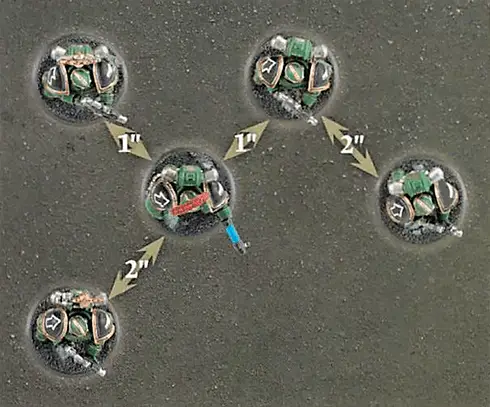
A Unit must remain in Unit Coherency while on the Battlefield. All Models in a Unit that is being moved must end that move in Unit Coherency - if they cannot then they may not be moved. When removing Models from a Unit, Models may be removed in a manner that means the Unit will no longer be in Unit Coherency, however, note this may lead to penalties being applied - see the Rules for Out of Coherency below.