Orks – Gorkanaut

RANGED WEAPONS | RANGE | A | BS | S | AP | D | |
| Deffstorm Mega-shoota - Aimed LETHAL HITS: non-MONSTER/VEHICLE | |||||||
| Deffstorm Mega-shoota - Aimed LETHAL HITS: non-MONSTER/VEHICLE | 36" | 20 | 5+ | 6 | -1 | 1 | |
| Deffstorm Mega-shoota - Point Blank Torrent | |||||||
| Deffstorm Mega-shoota - Point Blank Torrent | 12" | 3D6 | - | 6 | -1 | 1 | |
| Dual Big Shoota LETHAL HITS: non-MONSTER/VEHICLE Rapid Fire 4 | |||||||
| Dual Big Shoota LETHAL HITS: non-MONSTER/VEHICLE Rapid Fire 4 | 36" | 6 | 5+ | 5 | 0 | 1 | |
| Rokkit Launcha - Blasta BLAST 2 | |||||||
| Rokkit Launcha - Blasta BLAST 2 | 24" | 2 | 5+ | 5 | 0 | 1 | |
| Rokkit Launcha - Busta | |||||||
| Rokkit Launcha - Busta | 24" | 2 | 5+ | 10 | -2 | 3 | |
| Skorcha BLAST 1 Torrent | |||||||
| Skorcha BLAST 1 Torrent | 12" | 3 | - | 5 | 0 | 1 | |
MELEE WEAPONS | RANGE | A | WS | S | AP | D | |
| Klaw of Gork CLEAVE 3 | |||||||
| Klaw of Gork CLEAVE 3 | Melee | 6 | 3+ | 18 | -3 | 6 | |
| CORE ABILITIES | Damaged 7, Deadly Demise D6, Super-heavy Walker |
| ARMY RULES | Waaagh! |
- 1 Gorkanaut model
| YOUR 1ST TO 2ND UNITS COST | |
| 1 model | 325 |
| YOUR 3RD + UNIT COSTS | |
| 1 model | 355 |
ORKS
The JUMP PACK keyword is used in the following Orks datasheets:

The MEGA ARMOUR keyword is used in the following Orks datasheets:
The ORKS keyword is used in the following Orks datasheets:

The TITANIC keyword is used in the following Orks datasheets:
- The attacking model is on a section of a terrain feature that is 3" or more in height.
- The attacking model has the TOWERING keyword and the target unit is within 12".
The TOWERING keyword is used in the following Orks datasheets:
The TRANSPORT keyword is used in the following Orks datasheets:
The VEHICLE keyword is used in the following Orks datasheets:
The WALKER keyword is used in the following Orks datasheets:
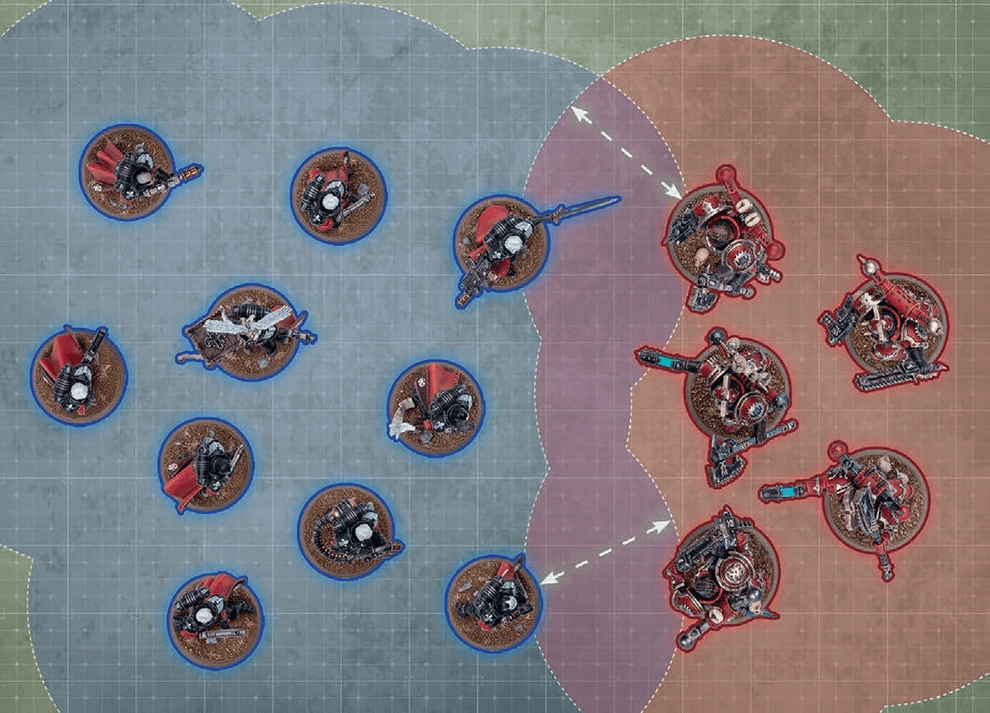
- While a friendly model is within engagement range of one or more enemy models, those models – and the units they belong to – are engaged with each other.
- While a unit contains no engaged models, that unit is unengaged.
FAQ
| Q: | Does my model or unit become engaged while moving through a enemy units engagement range during a move? |
| A: | No |
EFFECT: Your unit moves as described in Moving (03).
BEFORE MOVING: Make an advance roll by rolling one D6.
AFTER MOVING:
- Your unit must be unengaged.
- Until the end of the turn, unless otherwise stated, your unit is not eligible to declare a charge or start an action.
When a model is destroyed, first resolve any rules that are triggered when it is destroyed, then it is removed from the battlefield. If any such rules apply, and if the model was destroyed as the result of an attack, unless otherwise stated, those rules are only resolved and that model is only removed after the attacking unit’s attacks have been resolved. Unless otherwise stated, destroyed models and units cannot use abilities or be selected or targeted by rules.
Some rules only trigger if an enemy model or unit was destroyed by you, or by a model or unit from your army. This means that the enemy model or unit was destroyed by an attack made by a model from your army, or by a player rule you have. Enemy models or units that are destroyed by any other means are not destroyed by you, or by a model or unit from your army.
- Create Groups: Divide all models in the target unit into the following groups, as many times as required:
- One group for each CHARACTER model.
- One group for all other models with the same W, Sv and InSv characteristics.
- Allocation Order: Declare the order in which those groups will have attacks allocated to them, applying all of the following:
- If a non-CHARACTER group contains a model that has lost one or more wounds, that group must be first in the allocation order.
- No CHARACTER group can be earlier in the allocation order than a non-CHARACTER group.
- CHARACTER groups containing a model that has lost one or more wounds must be earlier in the allocation order than CHARACTER groups containing no wounded models.
- Make Save Rolls: The opposing player makes one save roll for each attack that wounded the target by rolling one D6.
FAQ
| Q: | When declaring the allocation order of groups in my unit I have more than one non-CHARACTER groups that contain a model with a missing wound, how must I select the order? |
| A: | Those groups can be selected in an order of your choosing but must be in an order that makes them come before any non-CHARACTER groups that do not contain a model with a missing wound. |
| Q: | I have a unit being attacked with weapons that will modify some of their save rolls to be worse then 6 should I make those save rolls? |
| A: | Yes, because other models in your unit may have Sv’s that are better those models you’ve mentioned, this means that enough save rolls could be allocated to the those models that the rest of the results are not greater then the Sv’s of the other models in your unit. |
| Q: | Can I group or allocate a wound to a destroyed model? |
| A: | No. |
Many deadly weapons can inflict fatal injuries on any foe, no matter their resilience.
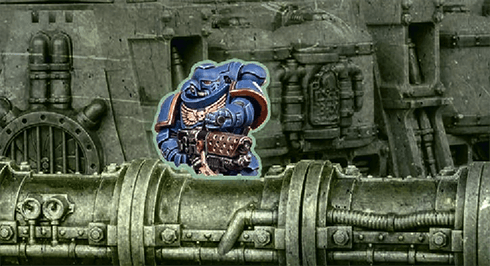
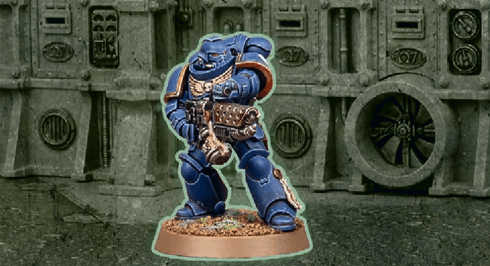
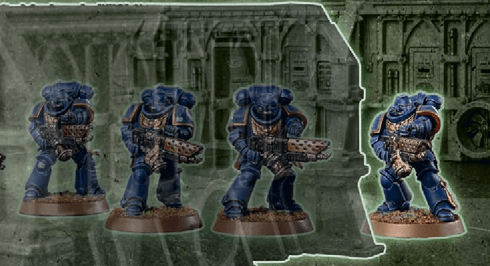
Each time an attack made with a [LETHAL HITS] weapon results in a critical hit, you can choose for that attack to automatically wound the target.Other models and units can be either visible or fully visible to the observing model, as shown below. Note that terrain applies additional rules to visibility (13.07).
FAQ
| Q: | When checking line of sight from one model to another, is this drawn between the bases of those models, or between any part of them? |
| A: | Line of sight is drawn from any part of the observing model to any part of the model being observed. |
EFFECT: Your unit shoots as described in Making Attacks (04).
WHILE SHOOTING:
- You can only target one visible enemy unit within 24" of your unit (and only if it is an eligible target).
- Each attack only hits on an unmodified hit roll of 6 (irrespective of the attacking weapon’s BS characteristic or any modifiers).
- You cannot re-roll hit rolls.
|
FAQ
| Q: | My attack has a rule that means it results in a critical hit on a hit roll of 4+. Does this work when snap shooting? |
| A: | Unless otherwise stated, no: when snap shooting, each attack only hits on a roll of 6. |
| Q: | My attack has a rule that means it results in a critical hit on a hit roll of 4+, and I would otherwise need a 5+ to hit. Does a 4+ hit? |
| A: | Yes, except when snap shooting: when snap shooting, each attack only hits on a roll of 6. |
Weapons powered by unstable and dangerous energy sources pose a substantial risk to the wielder and those that stand beside them.
Each time a unit is selected to shoot or selected to fight, after that unit has resolved all of its attacks, make a number of hazard rolls (06.03) for that unit equal to the number of [HAZARDOUS] weapons you selected in the Select Weapons step.- Select Model: Select one model in that unit by following the first instruction below that applies:

If a non-CHARACTER model in that unit has lost one or more wounds, you must select that model. Otherwise, if that unit contains one or more non-CHARACTER models, you must select one of those models. Otherwise, if one or more CHARACTER models in that unit have lost one or more wounds, you must select one of those models. Otherwise, you must select one CHARACTER model in that unit. - Resolve Damage: The selected model loses 1 wound. If this reduces that model’s remaining wounds to 0, it is destroyed.
MORTAL WOUNDS AND NORMAL DAMAGE
When resolving attack dice, if those attacks inflict a mixture of both mortal wounds and normal damage, resolve all of the normal damage first, then resolve all of the mortal wounds.
- Normal Damage 06.02.01
FAQ
| Q: | I have a rule that triggers when a mortal wound is allocated to a model, when does this happen? |
| A: | When you select a model in the Select Model step of Mortal Wounds (06.02). |
FAQ
| Q: | I failed hazard rolls from [Hazardous] weapons, do those mortal wounds have to be allocated to the models with the [HAZARDOUS] weapons? |
| A: | No, you allocate the mortal wounds to the unit as per Mortal Wounds (06.02). (This represents Bob the guardsmen picking up his fallen squad mates plasma gun or that the twisting power of James the Chaos Sorcerer pulling his followers into the warp.) |
| Q: | If a rule says my unit must make a hazard roll does every model in the unit make a hazard roll? |
| A: | No, the unit would make 1 single hazard roll. |
EFFECT: Your unit moves as described in Moving (03).
BEFORE MOVING: Select fall-back mode:
- Ordered Retreat: If your unit is not battle-shocked, you can select this mode.
- Desperate Escape: Otherwise, you must select this mode. Make a hazard roll for each model in your unit (06.03).
- Desperate Escape: Each model that is moved can be moved through enemy models.
- Your unit must be unengaged.
- Until the end of the turn, unless otherwise stated, your unit is not eligible to shoot, declare a charge or start an action.
- Desperate Escape: If your unit is not battle-shocked, you must make a battle-shock roll for your unit (01.07).
The infamous war cry of the Orks is known and feared throughout the galaxy. When it echoes across the battlefield, bellowed from countless toothy maws, it galvanises the Orks and riles them into a raucous state of excited aggression.
Friendly ORKS units with this ability can:- Re-roll advance rolls.
- Become riled up, as stated in other rules.
While a unit is riled up:- That unit has 5+ InSv.
- That unit’s ranged attacks have [ASSAULT].
- When that unit is selected to make an advance move, that advance move does not prevent that unit from being eligible to declare a charge.
The ORKS and INFANTRY keywords are used in the following Orks datasheets:
The ORKS and VEHICLE keywords are used in the following Orks datasheets:
With sufficient might or skill, warriors may sweep blades or talons through their foes in long lethal arcs.
This ability always takes the form [CLEAVE X]. Each time you gather attack dice for a [CLEAVE] weapon, if you only selected one target for all of that weapon’s attacks, add X additional attack dice for every five models that were in the target unit in the Select Targets step (rounding down).The ORKS and MOUNTED keywords are used in the following Orks datasheets:
Rapid fire weapons are capable of long-ranged precision shots or controlled bursts at nearby targets.
This ability always takes the form [RAPID FIRE X]. Each time you gather attack dice for a [RAPID FIRE] weapon, add X additional attack dice if the target unit was within half range of that weapon in the Select Targets step.Example: If a [RAPID FIRE 1] weapon with an A characteristic of 1 targets a unit that is within half range, you would gather one additional attack dice for that weapon (for a total of two for that weapon).
- If that roll succeeds, that unit does not become battle-shocked.
- If that roll fails, that unit, and each model in it, is battle-shocked.
While a unit is battle-shocked:
- The Objective Control (OC) characteristic of all of its models is modified to ‘-’ (02.02).
- Its controlling player cannot target that unit with stratagems (15).
- It is not eligible to start an action (16), and any action it has started cannot be completed.
- Battlefield Morale 01.07.01
- Battle-shock Test 01.07.02
FAQ
| Q: | If a unit has a rule that allows it to start an action when it is battle-shocked can it also continue doing that action if it becomes battle-shocked after starting an action? |
| A: | Yes |
| Q: | If a unit becomes battle-shocked after starting an action does it stop performing that action? |
| A: | Yes |
EFFECT: Your unit is set up as described in Set Up (03.02).
BEFORE MOVING: Your unit is set up as described in Set Up (03.02).
WHILE MOVING: Set up your unit wholly within the set-up distance of one or more battlefield edges and more than 8" horizontally from all enemy units.
- Before the Third Battle Round: While doing so, no models can be set up within your opponent’s deployment zone.
The most potent weapons strike with such power that they make a mockery of armour and can cleave through several foes.
Each time an attack made with a [DEVASTATING WOUNDS] weapon results in a critical wound, the attack sequence for that attack ends and the target unit suffers a number of mortal wounds equal to the D characteristic of that weapon. These are inflicted after resolving any normal damage inflicted by those attacks.Mortal wounds inflicted by [DEVASTATING WOUNDS] weapons can damage a maximum of one model for each critical wound; any remaining mortal wounds inflicted by that attack are lost.
- If the target unit is an attached unit, use the highest T characteristic amongst bodyguard models in that unit that are on the battlefield.
- Use the highest T characteristic amongst models in that unit that are on the battlefield.
| ||||||||||||||||||||||||||||||
- Multiple Toughness Characteristics 05.02.01
EFFECT: Your unit moves as described in Moving (03).
AFTER MOVING: Your unit must be unengaged.
Torrent weapons project clouds of fire, gas or other lethal substances that few foes can hope to evade.
Each time an attack is made with a [TORRENT] weapon, that attack automatically hits the target.The ORKS and TRANSPORT keywords are used in the following Orks datasheets:
Some weapons are so rare, or so complex and slow to reload, that they can only be used once.
Each weapon with this ability can only be selected to make attacks with once per battle.If a destroyed model is returned to a unit, all of its [ONE SHOT] weapons that have already been selected to make attacks with during the battle cannot be selected to make attacks with again.
If a new unit is added to an army, all [ONE SHOT] weapons in that unit can be selected to make attacks with once per battle.
Some transports have dedicated platforms or firing ports from which embarked passengers can lay down a withering hail of munitions.
This ability always takes the form Firing Deck X. In your Shooting phase, each time this TRANSPORT is selected to shoot, if one or more units are embarked within it, resolve the following sequence:- Select up to X models embarked within this TRANSPORT (excluding models whose units have already been selected to shoot this phase).
- For each selected model, select one of its ranged weapons (excluding [ONE SHOT] weapons).
- Until this TRANSPORT has resolved all of its attacks, it has all of those selected weapons in addition to its other weapons.
- Until the end of the turn, units embarked within this TRANSPORT are not eligible to shoot.
Weapons powered by unstable and dangerous energy sources pose a substantial risk to the wielder and those that stand beside them.
Each time a unit is selected to shoot or selected to fight, after that unit has resolved all of its attacks, make a number of hazard rolls (06.03) for that unit equal to the number of [HAZARDOUS] weapons you selected in the Select Weapons step.- Embarked within a TRANSPORT on the battlefield
- Did not embark within that TRANSPORT this phase
- That TRANSPORT has not made an advance/fall-back move this phase
WHILE MOVING: Set up each model wholly within the set-up distance of that TRANSPORT.
EFFECT: Your unit is set up as described in Set Up (03.02).
BEFORE MOVING: Make a hazard roll for each model in your unit (06.03).
WHILE MOVING: Set up each model in your unit: (1) Wholly within the set-up distance of that TRANSPORT, and as close as possible to that TRANSPORT. OR: (2) If the above is not possible while remaining unengaged, set up that model wholly within the set-up distance of that TRANSPORT, as close as possible to that TRANSPORT, and engaged. Each model that still cannot be set up is destroyed.
AFTER MOVING: Your unit is battle-shocked and, until the end of the turn, it is not eligible to declare a charge.
From detonating ammo stores to corrosive innards or frenzied death throes, some targets are deadly even in defeat.
This ability always takes the form Deadly Demise X. Each time a model with this ability is destroyed, after the units embarked within it (if any) have made their emergency disembark moves, roll one D6. On a 6, that model suffers a deadly demise; each unit within 6" of that model suffers a number of mortal wounds denoted by X (if this is a random number, roll separately for each unit within 6").Those possessed of lightning-fast reactions may strike before the opponent can react.
While every model in a unit has this ability, that unit is a Fights First unit.See the Resolve Fights First Combats step in the Fight phase (12.04).
High-explosive rounds can fell several warriors in a single blast, but firing them too close to comrades is unwise.
Each time you gather attack dice for a [BLAST] weapon, add one additional attack dice for every five models that were in the target unit in the Select Targets step (rounding down).If this ability takes the form [BLAST X], each time you gather attack dice for such a weapon, add X additional attack dice for every five models that were in the target unit in the Select Targets step (rounding down) instead.
Random Attacks: If a weapon has a random A characteristic, that characteristic is determined when generating attacks for that weapon at the Resolve Attacks step (04.03). If several weapons with random A characteristics are making identical attacks, generate the attacks for each of those weapons individually, and group them all together.
Random Damage: If a weapon has a random D characteristic, then each time an attack made with it inflicts damage, the controlling player determines that weapon’s characteristic when the opposing player has selected a model in the target unit to allocate that attack to.
When determining a random D characteristic, the dice roll made is called a damage roll.
Where a D characteristic includes an operator (e.g. a ‘+’, as in D6+1), the value after the operator is part of that D characteristic – it is not a modifier.
Other Random Characteristics: For all other characteristics, roll to determine the value on an individual, per-model or per-weapon basis each time that characteristic is required.
- Advance roll
- Charge roll
- Damage roll
- Hazard roll
- Hit roll
- Save roll
- Wound roll
- A roll to determine the number of attacks generated with a weapon.
TARGET: That unit or model.
EFFECT: You re-roll that roll. If you are rolling more than one dice together, select one of those dice to re-roll (excluding charge rolls, which you must re-roll in full).
TARGET: That unit.
EFFECT: That battle-shock roll is automatically successful.
RESTRICTIONS: You cannot use this stratagem more than once per battle.
TARGET: One friendly unit that is in strategic reserves (excluding AIRCRAFT).
EFFECT: Your unit makes an ingress move (20.04).
RESTRICTIONS: You cannot use this stratagem during the first battle round.
TARGET: One friendly unengaged unit within 12" of one or more enemy units. You can only select a VEHICLE unit if it is a CHARACTER/WALKER unit.
EFFECT: Resolve a charge with your unit (11.02). While doing so, before making the charge roll, you must select one of the following modes:
- Leap to Defend: When selecting charge targets, you can only select enemy units that made a charge move this phase and are within the maximum distance.
- Into the Fray:
- When making the charge roll, if the result is greater than 6 (after modifiers), change it to 6.
- When selecting charge targets, you can select any enemy units that are within 6" of your unit and within the maximum distance.
TARGET: One friendly unit that is eligible to fight.
EFFECT: Until the end of the phase, your unit has the Fights First ability and it must be the next unit you select to fight (12.04).
TARGET: That unit or model from your army.
EFFECT: You re-roll that roll, test or saving throw.
TARGET: The unit from your army that Battle-shock test was just taken for (even though your Battle-shocked units cannot normally be affected by your Stratagems).
EFFECT: Your unit is treated as having passed that test instead, and is not Battle-shocked as a result.
TARGET: One unit from your army that has not been selected to shoot this phase.
EFFECT: Select one model in your unit that is equipped with a weapon with the [BLAST] ability. Until the end of the phase, when determining how many models are in the target unit for the purpose of that ability, include models that are not visible to the attacking model. In addition, attacks made with that weapon can be allocated to models that are not visible to the attacking model.
TARGET: One unit from your army that is within Engagement Range of one or more enemy units and that has not already been selected to fight this phase.
EFFECT: Your unit fights next.
TARGET: That ORKS unit.
EFFECT: Your unit’s ranged attacks have:
- [Rapid Fire 1].
- Or: If that attack already has [RAPID FIRE], +1 to the value of that [RAPID FIRE] (e.g. [RAPID FIRE 1] becomes [RAPID FIRE 2]).
TARGET: That ORKS unit.
EFFECT: Your unit’s melee attacks have [Lethal Hits].
Joyously anarchic and recklessly destructive, all Orks eagerly get stuck in to every fight.
Friendly ORKS units’ melee attacks have [Sustained Hits 1].
Before the battle, in the Declare Battle Formations step, your units can start embarked within any friendly TRANSPORT model that has sufficient transport capacity remaining for the whole unit.
A friendly unit must be embarked within each friendly DEDICATED TRANSPORT model. At the end of this step, each friendly DEDICATED TRANSPORT model without an embarked unit is destroyed, but they do not trigger rules that are triggered when a model is destroyed.
EFFECT: Your unit moves as described in Moving (03).
BEFORE MOVING: Select one or more enemy units that are within 12" of your unit and within the maximum distance of your unit; until the end of this move, each of those enemy units is a charge target.
WHILE MOVING:
- Each model must end its move closer to one or more charge targets.
- Each model that can end its move within 1" of one or more charge targets must do so.
- Each model that can end its move engaged with one or more charge targets must do so.
- Your unit must be engaged with all of the charge targets.
- Your unit cannot be engaged with one or more enemy units that are not charge targets.
- Until the end of the turn, each model in your unit has the Fights First ability (24.13).
TARGET: That MONSTER/VEHICLE unit.
EFFECT: Resolve the following sequence:
- Select one enemy unit engaged with your unit.
- Select one model in your unit engaged with that enemy unit.
- Roll a number of D6 equal to the T characteristic of that model: for each 1, your unit suffers 1 mortal wound; for each 5+, that enemy unit suffers 1 mortal wound (to a maximum of 6 mortal wounds per unit).
Errata
TARGET: That ORKS MOUNTED/VEHICLE unit.
EFFECT: Your unit has +2" M.
TARGET: That ORKS TRANSPORT unit.
EFFECT: Your unit’s ranged attacks with weapons selected for the Firing Deck ability have +1 to hit rolls.
TARGET: One friendly ORKS WALKER unit.
EFFECT: Your unit is riled up until the start of your next turn.
TARGET: That ORKS WALKER unit.
EFFECT: Your unit has MOBILE.
Examples: Buildings, ruins, armoured containers, woods.
- Exposed/Light: All models can move horizontally and vertically through exposed and light terrain features.
- Dense:
- INFANTRY/BEASTS/SWARM/MOBILE models can move horizontally through dense terrain features.
- INFANTRY/BEASTS/SWARM models can move vertically through dense terrain features.
- Other models can move horizontally through dense terrain features provided that all sections of that terrain feature that the moving model’s base would move through are 2" or less in height. Otherwise, the moving model must move vertically to ascend or descend such sections. They cannot move through ceilings and floors while doing so, and they cannot end that move on any surface of that terrain feature that is not on ground level (see below).
- Solid Terrain and Movement 13.06.01
Monstrous creatures and gigantic engines of war loom over the battlefield like gods given form, striding over combatants and smashing through almost any obstacle that bars their passage.
Each time a unit with this ability makes a normal, advance or fall-back move:- Models in that unit can move through models (including MONSTER/VEHICLE models, but excluding TITANIC models) and can move horizontally through sections of terrain features that are 4" or less in height.
- Before moving that unit, you can select for all models in that unit to have the MOBILE keyword until that move ends. If you do, when that move ends, roll one D6: on a 1, that unit is battle-shocked.